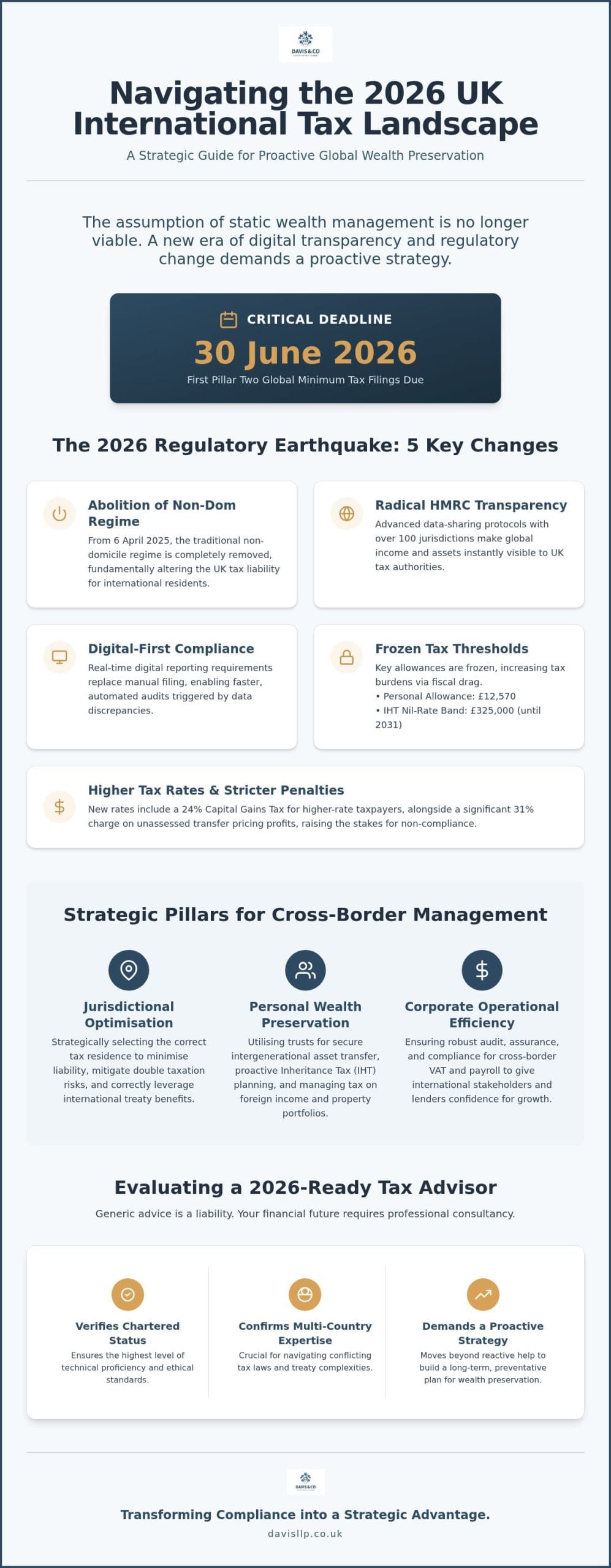
The assumption that international wealth can be managed through static, historical structures is no longer a viable strategy in the current regulatory environment. With the first Pillar Two global minimum tax filings due by 30 June 2026 and the total abolition of the traditional non-domicile regime, the necessity for proactive international tax planning uk has never been more acute. It’s understandable if you feel a sense of unease regarding how shifting HMRC regulations and the 31% charge on unassessed transfer pricing profits might impact your global interests.
We recognise that maintaining jurisdictional efficiency while protecting your family’s legacy requires more than just reactive accounting. This guide offers a structured framework designed to transform compliance into a strategic advantage and ensure the preservation of global wealth. We’ll explore how to mitigate the effects of frozen tax thresholds, manage the complexities of double taxation treaties, and implement robust measures for intergenerational security. By the end of this analysis, you’ll have the clarity needed to lead your financial affairs with renewed confidence and precision.
Key Takeaways
- Gain a clear understanding of the 2026 regulatory landscape, specifically how enhanced HMRC transparency protocols and digital reporting requirements affect your cross-border interests.
- Identify the strategic pillars of international tax planning uk to effectively manage the transition away from the non-domicile regime while maintaining jurisdictional efficiency.
- Learn to evaluate the technical proficiency of potential advisors by verifying Chartered status and specific multi-country expertise to ensure your portfolio remains compliant.
- Discover the value of a preventative approach to wealth management, moving beyond remedial tax help toward a long-term strategy for preserving intergenerational assets.
The Landscape of International Tax Planning in the UK for 2026
In its most fundamental sense, international tax planning is the strategic arrangement of financial affairs to minimise liability across multiple jurisdictions. It’s about ensuring that your global wealth is structured with precision, rather than left to the mercy of overlapping tax regimes. Effective international tax planning uk requires a deep understanding of the 2026 regulatory shifts, where the focus has moved from voluntary disclosure to mandatory transparency.
HMRC now utilises advanced data-sharing protocols with over 100 jurisdictions. This means that income generated in one corner of the globe is visible to authorities in another almost instantly. Understanding the principles of international taxation is no longer just for multinational corporations. Individuals with offshore assets or global income streams must adopt a proactive stance to stay ahead of these automated systems.
The shift toward digital-first compliance is now a reality. HMRC’s 2026 digital reporting requirements for international assets mean that manual, retrospective filing is being replaced by real-time data flows. This demands a higher level of accuracy; errors in reporting can trigger automated audits far more quickly than in previous years. We’ve seen that a reactive approach often leads to unnecessary penalties that could have been avoided with forward-looking structures.
The Role of Jurisdictional Optimisation
Choosing the correct tax residence is the foundation of long-term wealth preservation. It’s not just about where you live, but how your presence interacts with the interplay between UK domestic law and international treaties. Every jurisdiction has its own set of rules, and these often conflict. Professional advice serves as a vital safeguard to mitigate double taxation risks by ensuring that treaty benefits are correctly identified and claimed.
Why Outdated Tax Information is a Risk in 2026
Relying on guidance from 2021 to 2024 is a significant risk for the 2026 tax year. The landscape has changed fundamentally. For instance, the total abolition of the non-domicile regime from 6 April 2025 has completely altered the liability landscape for expats and residents alike. Recent fiscal changes, such as the 24% Capital Gains Tax rate for higher-rate taxpayers and the frozen personal allowance of £12,570, mean that strategies that worked two years ago may now result in unintentional non-compliance. Real-time professional interpretation of HMRC warnings is your best defence against the increased scrutiny of the current era.
Strategic Pillars of Cross-Border Wealth and Corporate Management
Developing a robust framework for international tax planning uk involves more than just basic compliance. It requires a dual-track approach that separates individual wealth preservation from corporate operational efficiency. For those with multi-jurisdictional interests, international tax planning acts as the connective tissue that aligns diverse assets with a single, cohesive financial vision. It’s common for SMEs to outgrow domestic frameworks; however, many stop short of the robust structures required for global expansion.
Audit and assurance play a critical role in this transition. By maintaining rigorous standards, businesses provide international stakeholders and lenders with the confidence needed for sustained growth. This transparency often leads to better credit terms and smoother cross-border transactions, reinforcing the synergy between business growth and tax-efficient structures.
Personal Tax, Trusts, and Intergenerational Wealth
Trust tax services are essential for the secure transfer of global assets. They ensure that family wealth remains protected across generations, particularly when assets are held in different legal systems. Addressing Inheritance Tax (IHT) is equally vital. With the Nil-Rate Band frozen at £325,000 until April 2031, fiscal drag is a real concern for those with non-UK interests. Understanding UK tax on foreign income is the first step in avoiding double taxation. For international landlords, property accounting provides the necessary oversight to manage UK portfolios without falling foul of local regulations.
Corporate Tax Strategy for International SMEs
Managing VAT compliance and payroll for teams operating across borders is a significant hurdle. It’s not just about paying the right amount. It’s about the timing and the specific jurisdictional rules involved. Management accounts are the primary tool for identifying tax-saving opportunities within international supply chains. These reports allow us to spot inefficiencies before they become liabilities. We also provide strategic advice for specialised sectors. As a dental tax specialist, we recognise that dental professionals with global investments require a specific approach that balances clinical practice income with international capital growth. If you require a bespoke approach to your global interests, our team can help you build a resilient financial future.
Professional Consultancy vs. Generic Advice: The Value Gap
Free resources and government portals provide a necessary baseline for simple PAYE queries or basic self-assessment. They serve a vital function for those in straightforward financial positions. However, these tools are inherently remedial. They’re designed to answer specific, narrow questions rather than provide a holistic strategy. For those with cross-border interests, the gap between generic advice and professional international tax planning uk is where wealth is often lost to jurisdictional inefficiency.
Professional consultancy is preventative by nature. It focuses on wealth-building and the long-term preservation of assets rather than merely filing a return. The opportunity costs of a DIY approach can be substantial. Missing out on Business Asset Disposal Relief (BADR), which sits at 18% from 6 April 2026, or failing to correctly apply international tax standards to foreign dividends can lead to significant overpayment. We view professional fees as a strategic investment in your financial stability, not a recurring cost.
The Tipping Point for Professional Intervention
Financial complexity usually reaches a tipping point when income streams cross national borders. This is when the expertise of a Chartered Certified Accountant becomes essential. While AI-driven tax software has improved, it remains limited. It can’t handle the nuanced, qualitative aspects of tax residency or the subtle interaction of multiple treaties. For a deeper look at these requirements, you can refer to our guide on expert tax advice in the UK. Relying on software for complex cross-border scenarios often results in unintentional non-compliance.
Niche Expertise and Industry-Specific Advantages
Certain sectors demand a more granular level of knowledge. For example, dental tax specialists are required for medical professionals whose earnings often involve complex partnership structures and global investments. Managing these sensitive matters requires a sense of composed partnership and discretion. Our firm’s history, dating back to 1901, provides a foundation of reliability that generic platforms simply can’t replicate. This deep-seated expertise ensures that every decision is backed by a century of professional success and a commitment to individualized service delivery.
Evaluating an International Tax Advisor: A Framework for 2026
Selecting a partner for international tax planning uk is a decision that impacts both current liquidity and long-term legacy. It’s not a choice that should be dictated by geographical proximity or aggressive marketing. Instead, it requires a structured evaluation of technical proficiency and historical reliability. In an era of automated HMRC scrutiny, the quality of your advisor is your primary line of defence.
Verification of ACCA and Chartered status remains the non-negotiable baseline for any engagement. These credentials ensure that your advisor adheres to the highest ethical and technical standards in the profession. Beyond these certifications, you must assess jurisdictional proficiency. It’s vital to confirm whether a firm has direct experience with the specific countries involved in your portfolio. Surface-level knowledge of treaty rates isn’t enough; you need an advisor who understands the practical application of foreign tax credits and local reporting nuances.
Longevity offers a perspective that newer firms simply cannot replicate. A firm established in 1901 has navigated every major fiscal cycle of the last century. This history allows us to distinguish between temporary legislative trends and fundamental shifts in global tax policy. The benefit of having audit, tax, and growth advisory under one roof is also significant. It creates a cohesive feedback loop that ensures your corporate strategy never conflicts with your personal tax position.
Critical Questions for Potential Partners
When interviewing a prospective firm, move beyond generalities. Ask specifically how they approach double taxation treaties and the rising frequency of HMRC enquiries. Inquire about their direct experience in managing family offices with multi-jurisdictional assets. These are the areas where subtle errors lead to significant liabilities. You can find a chartered accountant using our strategic selection guide to ensure your chosen partner meets these rigorous criteria.
Transparency and the ROI of Professional Fees
The most productive professional relationships move the discussion from “cost” to “value added.” High-calibre advice is a mechanism for risk mitigation. By identifying potential liabilities before they crystalise, a strategic partner provides a return that far outweighs the initial fee. We believe in clear, understated communication regarding all fee arrangements. This transparency fosters a sense of composed partnership, positioning us as a steady constant in a volatile financial environment. If you’re looking to secure your global interests, we invite you to speak with our senior partners to discuss a tailored strategy for your portfolio.
Davis & Co LLP: Professional Gravitas in International Tax Strategy
Davis & Co LLP operates with a sense of quiet excellence that has defined our practice for over 125 years. As an independent firm of Chartered Certified Accountants established in 1901, we provide the deep-seated expertise required for sophisticated international tax planning uk. We don’t believe in loud marketing; instead, we rely on a reputation built through a history of professional success and a commitment to absolute discretion. This reliability is essential when dealing with the sensitive commercial and personal matters that define a global financial portfolio.
Our approach is highly individualised, ensuring that every client receives a strategy tailored to their specific jurisdictional needs. For SMEs managing the complexities of cross-border growth, we act as a strategic small business accountant, providing the oversight necessary to maintain compliance while accelerating expansion. We provide equal weight to both organisational and individual service areas, recognising that for many of our clients, these two worlds are inextricably linked. This balanced perspective allows us to manage Personal Tax and Trust Tax for complex estates with the same rigour we apply to corporate structures.
Specialized Support for High-Calibre Clients
We have developed niche expertise as dental tax specialists and property accounting experts, catering to the unique needs of medical professionals and international landlords. These portfolios often involve intricate layers of income that require a precise, analytical touch. Our audit and assurance services further support this by providing stakeholders with composed confidence in the accuracy of financial reporting. We understand the human impact of complex international tax issues, and we aim to make our clients feel secure and well-advised through a style of composed partnership.
A Dependable Constant in a Volatile Economy
The UK economy has faced numerous shifts since our founding in 1901, yet our firm has remained a stable presence for our clients. This longevity allows us to offer a unique perspective on fiscal cycles, ensuring that your long-term planning isn’t derailed by short-term volatility. We avoid aggressive hyperbole in favour of an understated, intellectual approach to financial management. This rhythmic consistency helps to build trust, positioning us as a strategic partner rather than a mere service provider. If you’re seeking a partner who understands the practical realities of your global operations, we invite you to engage Davis & Co LLP for a comprehensive international tax consultation.
Securing Your Global Legacy in a Transparent Era
The transition into the 2026 tax year demands a fundamental shift from reactive reporting to proactive jurisdictional optimisation. With the abolition of the non-domicile regime and the implementation of Pillar Two rules, the environment for international tax planning uk has become significantly more complex. Relying on outdated guidance or basic software isn’t sufficient to protect multi-jurisdictional assets from the risks of double taxation or unintentional non-compliance. It’s vital to have a framework that anticipates regulatory change rather than merely reacting to it.
Success in this landscape requires a strategic partner with the technical depth to manage both personal wealth and corporate interests with precision. As Chartered Certified Accountants established in 1901, we provide the specialist international tax and trust expertise necessary to navigate these volatile markets. We invite you to Consult with our Chartered Certified Accountants to discuss a tailored strategy for your portfolio. By addressing these complexities now, you can lead your financial affairs with the confidence that your global legacy remains secure and well-advised.
Frequently Asked Questions
What is the primary difference between a tax advisor and a chartered accountant for international planning?
A chartered accountant, specifically a Chartered Certified Accountant, has undergone rigorous professional training and is regulated by a professional body like the ACCA. This ensures a high standard of technical proficiency and ethical conduct. While many individuals call themselves tax advisors, a chartered accountant provides a broader scope of integrated financial oversight, including audit and assurance. This is essential for complex international tax planning uk where personal and corporate interests overlap.
How much does professional international tax advice cost in the UK for 2026?
Professional fees for international tax advice are typically determined by the complexity of the jurisdictional portfolio and the specific technical requirements involved. We don’t provide generic price lists as every client’s situation is unique. Instead, we focus on the value added through risk mitigation and the preservation of global wealth. Clear, understated fee arrangements are discussed during the initial consultation to ensure transparency and align with your long-term financial objectives.
Can a UK-based tax advisor help with income earned in the US or EU?
Yes, a UK-based advisor with multi-jurisdictional expertise can manage income streams originating in the US or EU. We focus on the interplay between UK domestic law and international double taxation treaties to ensure your income isn’t taxed twice. This involves identifying the correct tax residence and applying treaty benefits accurately. Our firm’s century-long history provides the necessary experience to handle these complex cross-border financial interests with precision and discretion.
When is the best time to start international tax planning for the 2026/27 tax year?
The ideal time to begin planning is well before the start of the tax year on 6 April 2026. Early intervention allows for the implementation of robust structures that can mitigate the impact of frozen thresholds and shifting HMRC regulations. Reactive planning often leads to missed opportunities for reliefs or unintentional non-compliance. Starting early ensures that your jurisdictional optimisation is fully established before new reporting requirements or fiscal changes take effect.
Do I need a specialist dental tax accountant if I have international investments?
If you are a dental professional, a specialist dental tax accountant is highly beneficial for managing the unique interaction between clinical income and global investments. Dental earnings often involve complex partnership structures that require specific industry knowledge. We combine this niche expertise with high-calibre international tax planning uk to provide a cohesive financial strategy. This ensures that your professional practice income and offshore assets are managed under a single, expert framework.
How do double taxation treaties protect my income from being taxed twice?
Double taxation treaties are agreements between two countries that determine which jurisdiction has the primary right to tax specific types of income. They protect your wealth by providing tax credits or exemptions to prevent the same income from being taxed in both the UK and another country. Correctly applying these treaties requires a deep understanding of international taxation principles. We ensure that these agreements are utilised to maximise your jurisdictional efficiency and wealth preservation.
What should I do if I receive a 2026 HMRC tax warning regarding offshore assets?
You should seek professional advice immediately from a Chartered Certified Accountant if you receive a formal warning or enquiry from HMRC. These warnings often result from automated data-sharing protocols and require a precise, technical response to avoid penalties. It’s vital not to ignore these communications. We provide a calm, reassuring authority in managing these sensitive matters, ensuring that your disclosures are accurate and that your interests are protected throughout the process.
Is it possible to manage complex international tax compliance using HMRC’s online tools?
HMRC’s online tools are designed for straightforward domestic compliance and often lack the nuance required for complex cross-border scenarios. While they facilitate basic reporting, they don’t provide the strategic insights needed for jurisdictional optimisation or wealth preservation. Relying solely on these portals for multi-country interests carries a high risk of unintentional errors. Professional oversight ensures that your reporting meets the 2026 digital requirements while identifying strategic opportunities that automated tools simply overlook.