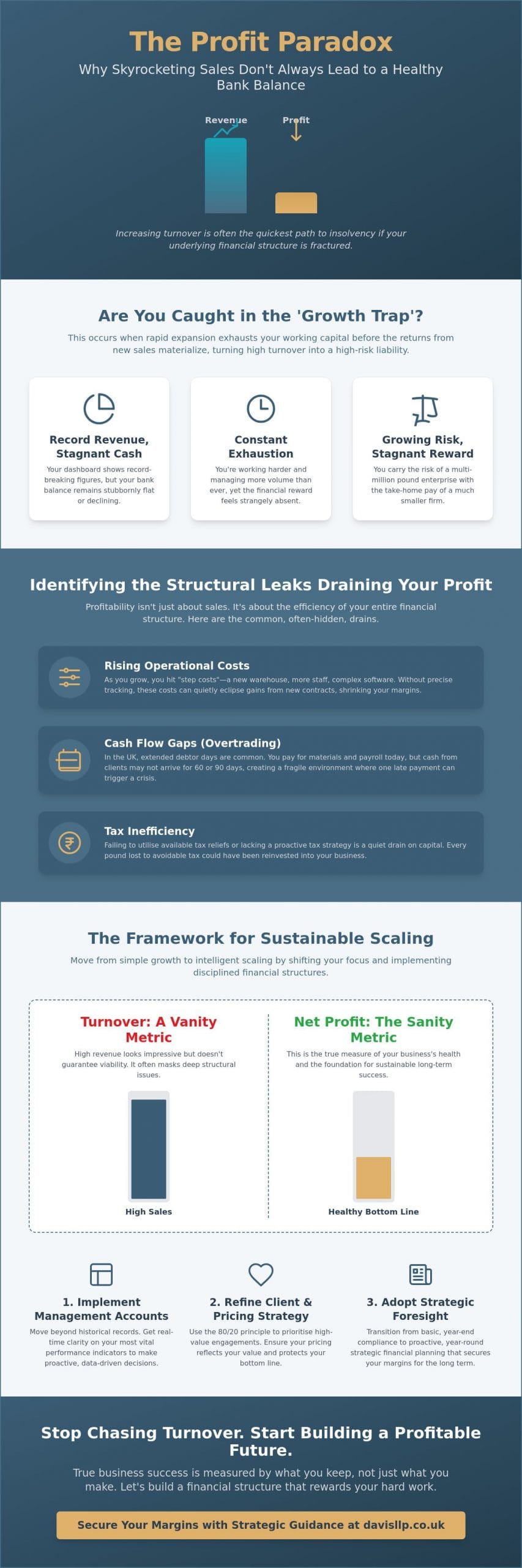
Increasing your turnover is often the quickest path to insolvency if your underlying financial structure is fractured. It is a common and exhausting paradox to see record-breaking revenue figures on your dashboard while your bank balance remains stubbornly stagnant. You have put in the work, managed the volume, and yet the financial reward feels strangely absent. This disconnect often leads to a persistent sense of confusion as you wonder, why is my business not profitable despite sales? The fear of overtrading is a valid concern, particularly when rapid growth phases demand more liquid cash than they currently generate.
We understand the stress of managing high-volume operations without reaping the expected rewards. While 74% of small business owners expect increased revenue in 2026, many will find that growth alone does not guarantee a healthy bottom line. This guide will help you identify the hidden financial drains and structural inefficiencies that prevent high-revenue businesses from achieving true profitability. We will provide a clear framework to distinguish between simple growth and sustainable scaling, offering actionable steps to secure your margins and improve your cash flow management through disciplined structural changes.
Key Takeaways
- Distinguish between growth and scaling to ensure your infrastructure supports your volume without eroding margins.
- Uncover the common structural drains that explain why is my business not profitable despite sales, including often-overlooked tax and operational inefficiencies.
- Move beyond historical records by implementing Management Accounts that provide real-time clarity on your most vital performance indicators.
- Refine your client selection and pricing strategies using the 80/20 principle to prioritise high-value engagements that respect your bottom line.
- Transition from basic compliance to strategic foresight by integrating Business Growth Acceleration into your long-term financial planning.
The Paradox of Revenue: Why Sales Success Often Masks Profit Failure
Many directors find themselves in a cycle where business growth feels like a burden rather than a reward. You might be processing more orders than ever, yet your net position remains precarious. This is the central tension for those asking, why is my business not profitable despite sales? It’s essential to recognise that turnover is a vanity metric, while net profit represents the true sanity of your operations. High revenue looks impressive in a pitch deck, but it doesn’t guarantee the long-term viability of the firm.
Scaling without the requisite financial infrastructure creates a “growth trap.” As volume increases, so does the complexity of your supply chain, staffing needs, and administrative overheads. Without rigorous profitability analysis, these rising costs can easily eclipse the gains from new contracts. The psychological weight of this situation is significant. Directors often feel they’re running faster just to stand still, carrying the risk of a multi-million pound enterprise with the personal take-home pay of a much smaller firm. This disparity breeds a unique form of exhaustion that can lead to strategic paralysis.
Understanding Overtrading in the UK Market
Overtrading occurs when a business expands its operations too rapidly, exhausting its working capital before the returns from those new sales materialise. In the UK market, this is frequently exacerbated by extended debtor days and delayed payments from larger clients. You’re paying for materials and payroll today, but your cash isn’t arriving for 60 or 90 days. Overtrading is a state where business obligations outpace liquid resources. This mismatch creates a fragile environment where one late payment can trigger a full-scale cash flow crisis, making professional Cash Flow Management an absolute necessity for survival.
The Diminishing Returns of Volume
The myth of “economies of scale” often lures mid-sized businesses into low-margin contracts. While buying in bulk might save pennies, the operational complexity of managing those larger volumes often costs pounds. As you grow, you hit “step costs” where you suddenly need a larger warehouse, a more sophisticated ERP system, or additional layers of management. If these costs aren’t managed through precise Management Accounts, the break-even point shifts further away with every new sale. Unmanaged growth doesn’t lead to efficiency; it leads to a bloated structure that consumes profit before it reaches the bottom line.
Identifying Structural Leaks: Beyond Basic Overheads
While standard overheads like rent and utilities are simple to monitor, structural leaks are often obscured within the finer details of your ledger. If you’re questioning why is my business not profitable despite sales, the answer often lies in the friction between your Cost of Goods Sold (COGS) and your operating expenses (OpEx). We frequently observe businesses where direct costs rise in lockstep with revenue, effectively capping the potential for net profit growth. This lack of “margin expansion” means that despite a busier team and higher turnover, the actual surplus remains static or even declines.
Structural leaks aren’t just about spending too much on subscriptions or office supplies. They’re often built into how the business is legally and operationally organised. For example, a lack of clarity in Bookkeeping Services can lead to the misclassification of expenses, which prevents you from seeing which service lines are truly profitable and which are merely “buying” revenue at a loss. Without this granular visibility, you’re steering a large ship without a working compass.
Tax Inefficiency as a Profit Killer
Failing to utilise available tax reliefs is a quiet drain on your capital that compounds over time. When tax strategy is treated as a year-end compliance task rather than a year-round priority, you’re essentially handing over funds that could have fueled your next growth phase. Implementing international tax planning is vital for firms with cross-border interests to protect global margins from double taxation or inefficient entity structures. Errors in Corporation Tax calculations or a lack of coordination between business and Personal Tax for directors can significantly erode the wealth your hard work has generated. Every pound lost to avoidable tax friction is a pound that didn’t reach your bottom line.
Operational and Cross-Border Frictions
International supply chains introduce jurisdictional complexities that many businesses aren’t equipped to handle in-house. Currency fluctuations can create a disparity between your paper profit and the actual cash realised in your accounts. Additionally, “VAT drag” occurs when VAT Compliance processes are slow or inaccurate, tying up vital liquidity in the tax system. Seeking expert tax advice in the UK is a necessary step to identify and plug these structural leaks before they compromise your stability. Our team can provide the necessary Management Accounts to ensure your margins remain intact as you expand. It’s the cumulative effect of these small, technical inefficiencies that leaves directors wondering why is my business not profitable despite sales.
The Role of Management Accounts in Navigating Growth
Statutory accounting serves a specific, regulatory purpose, yet it offers little value for day-to-day decision-making. Relying on year-end figures is like trying to drive a car while looking exclusively in the rear-view mirror. You see where you’ve been, but you can’t anticipate the obstacles ahead. If you’re struggling to understand why is my business not profitable despite sales, you require the granular detail found only in robust Management Accounts. These reports transform raw data into a steering tool, allowing you to identify cost overruns and operational bottlenecks in real-time.
In a volatile UK economic environment, where the prime interest rate sits at 6.75%, the cost of capital is too high to permit financial guesswork. We utilise variance analysis to compare your actual performance against your projections. This process highlights exactly where your margins are being eroded, whether through rising supplier costs or internal inefficiencies. By catching these discrepancies early, we can implement corrective measures before they escalate into a cash flow crisis. It’s the difference between being a passenger in your business and being its pilot.
Moving Beyond Compliance-Based Accounting
Monthly management reporting is the gold standard for any business serious about scaling. While statutory accounts satisfy legal obligations, they’re often too high-level to be actionable. A strategic small business accountant uses this monthly data to build sophisticated forecasts. We look at your historical performance not as an end point, but as a foundation for predicting future profitability. This proactive approach ensures you aren’t just reacting to your bank balance, but actively shaping it through informed strategy.
Crucial Profitability Metrics to Track
Understanding which metrics to monitor is as important as the frequency of the reports themselves. Many directors focus on Gross Margin, but Contribution Margin is often a more revealing metric for those wondering why is my business not profitable despite sales. It shows the actual surplus available to cover your fixed overheads after all variable costs are deducted. We also pay close attention to several vital indicators:
- Debtor Days: There’s a profound link between the time it takes to collect payments and your overall profitability. Slow collections drain your working capital and increase your reliance on expensive short-term financing.
- The Burn Rate: This is especially relevant for established businesses undergoing strategic pivots or rapid expansion. It measures how quickly you’re consuming cash reserves before the new revenue streams become self-sustaining.
By tracking these KPIs through our tailored Management Accounts and Bookkeeping Services, you gain the clarity needed to navigate growth without sacrificing your net profit. This level of oversight ensures that every new sale contributes meaningfully to your wealth rather than just adding to your workload.
Strategic Pricing and High-Value Client Selection
A common misconception in competitive UK sectors is that high turnover inevitably leads to high profit. This belief often fuels a race to the bottom, where firms undercut competitors to secure volume at any cost. If you’ve been examining your accounts and asking why is my business not profitable despite sales, the answer frequently lies in the composition of your client base. High-volume, low-margin work consumes the same operational resources as high-value engagements but offers far less resilience against rising costs and economic shifts.
Strategic profitability requires the courage to apply the 80/20 rule to your current portfolio. It’s often the case that 20% of your clients generate 80% of your actual profit, while the remainder provides the bulk of your administrative burden. We’ve seen that businesses which transition from cost-plus pricing to value-based models often see an immediate improvement in their net position. This shift moves the conversation away from “how much does it cost us to do this” to “what is the tangible value we are delivering to the client.”
The True Cost of Service Delivery
Calculating the true cost of a project involves more than just direct materials or labor. You must account for hidden time, including administrative overheads, ongoing communication, and the inevitable impact of scope creep. Many directors overlook these factors, leading to engagements that appear profitable on paper but are loss-making in practice. Drain clients often demand disproportionate attention for minimal financial return, effectively subsidising their needs with the profits from your better accounts. Every hour spent on low-margin work is an opportunity cost against high-value strategy.
Implementing Strategic Price Increases
With inflation sitting between 2.4% and 2.7% in early 2026, maintaining static pricing is a recipe for margin erosion. More than half of small business leaders recently implemented or planned price hikes in the high single or double digits to protect their bottom line. To justify premium positioning, you must communicate the specific outcomes and reliability you provide. Tiered pricing structures can also help by allowing clients to choose a service level that matches their budget while ensuring your minimum margin is protected. Benchmarking your rates against the UK professional services landscape ensures you remain competitive without sacrificing your financial health. To begin refining your commercial model, consider how our Business Growth Acceleration services can help you identify more lucrative revenue streams.
Partnering for Profitability: Beyond Compliance to Growth
Resolving the persistent question of why is my business not profitable despite sales requires a fundamental shift in how you view your financial advisors. Many directors treat accounting as a necessary compliance burden, a year-end exercise to satisfy regulatory requirements. However, true structural profitability is achieved when your accountant transitions into a strategic partner. We don’t merely record your financial history; we provide the intellectual rigour and analytical oversight necessary to shape your future. This collaborative approach ensures that your financial structure is robust enough to support your ambitions without compromising your net position.
Our Audit and Assurance services serve as a rigorous diagnostic tool in this process. Beyond the statutory requirements, an audit can reveal internal control weaknesses that are quietly leaking profit. Whether it’s inefficiencies in your procurement processes or lack of oversight in your Payroll Services, these small fractures can aggregate into a significant financial drain. By identifying and plugging these leaks, we help you reclaim the margins that your sales volume should naturally produce. We believe that every pound saved through operational efficiency is just as valuable as a pound earned through new business.
Strategic Financial Oversight
Achieving sustainable growth requires a multi-disciplinary approach that integrates International Tax Planning, Management Accounts, and long-term growth strategy into a single, cohesive vision. At Davis & Co LLP, we facilitate this through tailored, partner-led advisory. We look at the human and organisational impact of your financial decisions, ensuring that your corporate structure remains agile. By providing a high-calibre, trusted perspective, we help you navigate the complexities of modern commerce with composed confidence. We position ourselves as a strategic partner, focusing on highly individualised service delivery that respects the unique nuances of your practice or firm.
Actionable Steps for Immediate Review
To begin the process of reclaiming your profitability in 2026, we recommend a comprehensive financial health check. This involves moving beyond surface-level turnover and examining the structural integrity of your operations. You can take several immediate steps to gain clarity:
- Trend Analysis: Review the last six months of your management data to identify emerging patterns in cost overruns or declining margins.
- Portfolio Audit: Conduct a rigorous review of the top 10% and bottom 10% of your clients. Identify which engagements are truly contributing to your wealth and which are merely consuming resources.
- Compliance Check: Ensure you’re fully aligned with the latest HMRC tax warnings to avoid unexpected penalties or interest charges that can erode your cash reserves.
Our Business Growth Acceleration services are designed to help you identify and capitalise on new, high-margin revenue streams while maintaining disciplined Cash Flow Management. By partnering with us, you gain more than a service provider; you gain a dependable constant in a volatile market. It’s time to move beyond the confusion of high-volume, low-reward operations and build a business that is as profitable as it is busy.
Securing Your Financial Future Through Structural Discipline
Building a resilient enterprise requires moving beyond the allure of high turnover to address the underlying structural integrity of your finances. The persistent question of why is my business not profitable despite sales is usually answered through a combination of rigorous cost analysis and strategic tax planning. By implementing monthly management reporting and refining your client portfolio to prioritise high-margin engagements, you transform your business from a high-volume operation into a sustainable, wealth-generating asset.
As Chartered Certified Accountants with over 120 years of expertise, we provide a tailored, partner-led approach to solving your most complex financial challenges. We specialise in international tax planning and business growth acceleration, ensuring your operations are both compliant and commercially optimised. Discover how our Business Growth and Management Accounting services can transform your profitability.
With the right strategic oversight and a commitment to structural discipline, your business can achieve the clarity and financial reward your hard work deserves. We’re here to ensure your growth is as sustainable as it is ambitious.
Frequently Asked Questions
Can a business be profitable but have no cash?
Yes, profitability and liquidity are entirely separate financial states. Profit is an accounting concept recorded at the point of sale, whereas cash is the actual currency available in your bank account. Your profits might be tied up in unpaid invoices, high stock levels, or used to fund capital assets, leaving you with a healthy balance sheet but no liquid funds to meet immediate obligations.
How often should I review my business profit margins?
We recommend a comprehensive review of your profit margins at least once a month. Monthly reviews through robust Management Accounts allow you to identify negative trends or cost overruns before they become systemic issues. This frequency provides the agility needed to adjust pricing or operational structures in response to the volatile economic conditions currently facing UK businesses.
What is the most common reason for a business to fail despite high sales?
Overtrading is the most frequent cause of failure for high-revenue businesses. This occurs when a firm expands its operations more quickly than its working capital can support. The resulting cash flow gap often leads to insolvency, even if the business appears successful on paper. This is often the underlying answer when directors ask why is my business not profitable despite sales.
Is it better to focus on cutting costs or increasing prices for profitability?
While both strategies are valid, strategic price increases typically provide a more direct path to margin expansion without the diminishing returns of aggressive cost-cutting. Lowering expenses can only go so far before it compromises the quality of your service or product. In contrast, refining your pricing model to reflect the true value you provide can significantly improve your net position with less operational disruption.
How can a Chartered Accountant help me increase my business profit?
A Chartered Accountant acts as a strategic partner by providing Management Accounts that move beyond basic compliance. We help you identify specific profit leaks, optimise your tax position through International Tax Planning, and implement Business Growth Acceleration strategies. Our role is to provide the analytical rigour necessary to turn high sales volume into tangible, distributable wealth for the directors and stakeholders.
What is the difference between gross profit and net profit?
Gross profit represents the surplus remaining after deducting the direct costs of goods or services sold from your total revenue. Net profit is the final figure after all other operating expenses, interest, and taxes have been subtracted. While gross profit indicates the efficiency of your production or service delivery, net profit reveals the true health and sustainability of your entire business structure.
Why is my net profit margin decreasing as my sales increase?
A shrinking margin during a growth phase is a common sign of structural inefficiency or “step costs.” As you scale, you may find that overheads like payroll and administration grow faster than your revenue. This is a central paradox for those asking why is my business not profitable despite sales. It requires a disciplined review of your operational complexity to ensure that every new sale remains profitable.
What are the signs that my business is overtrading?
The most prominent signs of overtrading include a persistent reliance on short-term financing and a widening gap between turnover and available cash. You might also notice that your debtor days are increasing or that you’re struggling to pay suppliers on time despite record sales. If your working capital is constantly stretched to its limit, it’s a clear signal that your growth is outpacing your financial infrastructure.