Could a single pound of additional income inadvertently trigger a five-figure tax charge or a significant reduction in your take-home pay? For many dental practitioners, the complexity of the 2015 CARE scheme and its interaction with personal tax thresholds creates a sense of persistent uncertainty. We understand that while you value the long-term security of the scheme, the lack of clarity regarding nhs superannuation for dentists explained in modern terms can make proactive planning feel like a moving target. You likely feel the weight of these decisions as you balance clinical excellence with the necessity of building a stable financial legacy.
In this strategic guide, we provide the technical precision and professional insight necessary to navigate your pension obligations with confidence. We’ll explore the 2026/27 contribution tiers, the practical implications of the McCloud remedy choice, and the nuances of calculating Net Pensionable Earnings within current contract limits. Our objective is to move beyond mere compliance, offering you a clear framework to mitigate tax liabilities and ensure your retirement strategy remains robust. By examining these complex variables through a strategic lens, we can help you regain control over your financial trajectory and retire on your own terms.
Key Takeaways
- Gain a clear understanding of the 2015 CARE scheme’s structure and how the transition for all active members affects your projected retirement benefits.
- Evaluate how nhs superannuation for dentists explained within the framework of the 2026 contribution tiers allows for the precise calculation of Net Pensionable Earnings.
- Identify and manage the “pension tax trap” by monitoring pension growth against the Annual Allowance and navigating the tapering rules for high earners.
- Assess your options under the McCloud remedy to ensure you choose the most advantageous scheme benefits for the 2015–2022 remedy period.
- Understand why reconciling administrative data with professional tax returns is vital for identifying errors and securing the integrity of your pension record.
What is NHS Superannuation for Dentists?
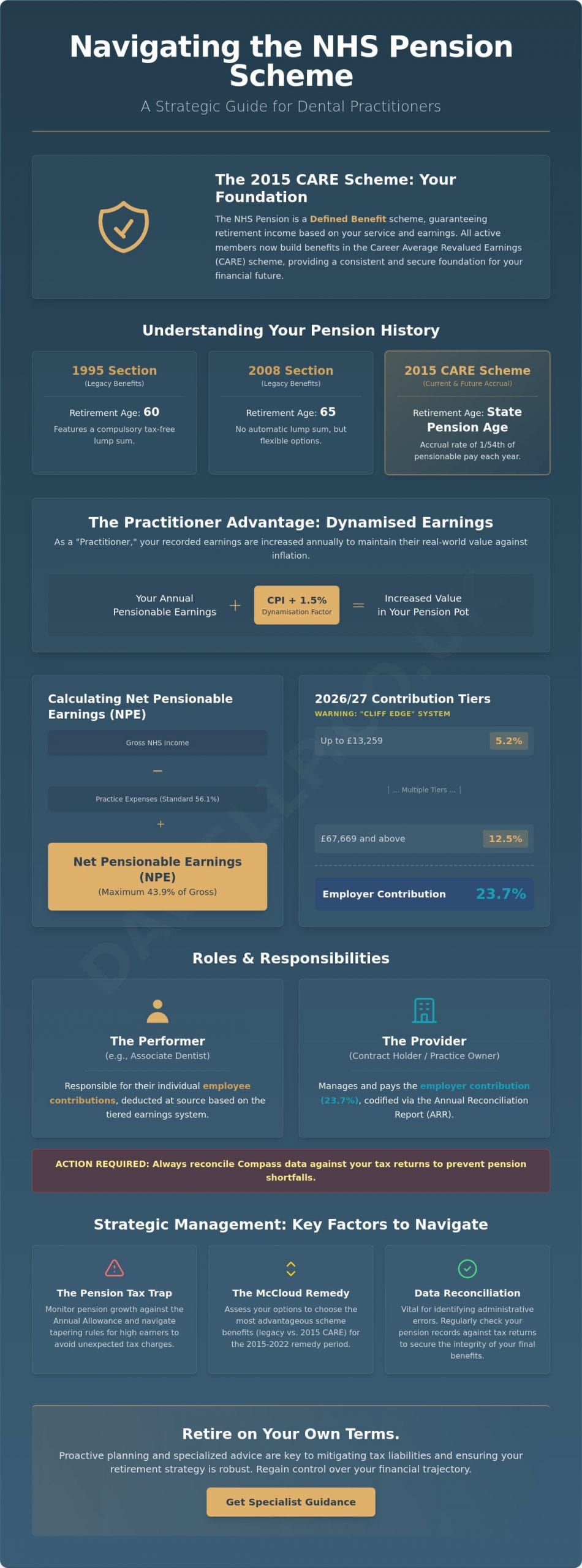
NHS superannuation is a robust, government-backed defined benefit scheme, representing a cornerstone of financial security for the dental profession. Unlike defined contribution plans where the final pot depends on investment performance, this scheme guarantees a specific level of retirement income based on your earnings and length of service. When looking at nhs superannuation for dentists explained in the current climate, it’s vital to recognize that as of 2026, all active members have transitioned to the 2015 Scheme. This shift marks a move from final salary or older career-average models to a unified Career Average Revalued Earnings (CARE) structure, ensuring a consistent approach across the public sector.
While the 2015 section is now the standard for active accrual, many practitioners still hold significant legacy benefits in the 1995 or 2008 sections. The 1995 section generally offers a retirement age of 60 with a compulsory tax-free lump sum, whereas the 2008 section sets the retirement age at 65. Understanding how these distinct periods of service interact is a primary challenge for modern clinicians. For a broader context on the legal and historical framework of these tiers, a comprehensive NHS Pension Scheme overview clarifies how these sections evolved over several decades. Providing a clear framework for nhs superannuation for dentists explained helps ensure that your clinical success translates into a secure retirement.
The Practitioner Status Explained
Dentists occupy a unique position within the NHS hierarchy. Unlike hospital staff who fall under “Officer” rules, dentists are classified as “Practitioners” regardless of whether they are associates or practice owners. This distinction is fundamental because it dictates how your pensionable pay is recorded and valued. Your benefits are calculated using Dynamised Career Average Revalued Earnings. Each year, your pensionable earnings are recorded and then dynamised, which means they’re increased by a specific factor, typically the Consumer Price Index (CPI) plus 1.5%. This mechanism is designed to ensure your future pension maintains its real-world purchasing power against inflation, reflecting the long-term value of your clinical contributions throughout your career.
Performer vs. Provider Contributions
The administrative burden of the scheme is split between the Performer and the Provider. Performers, often associates, are responsible for their individual employee contributions, which are deducted at source based on their tiered earnings. Conversely, the Provider, or the contract holder, manages the employer contribution, which currently stands at 23.7% for the 2026/27 period. This relationship is codified annually through the Annual Reconciliation Report (ARR). We often find that discrepancies in the ARR can lead to significant under-reporting of pensionable pay. It’s essential to reconcile your Compass data against your actual clinical activity and tax returns to prevent future shortfalls in your entitlement.
Calculating Net Pensionable Earnings (NPE) and Contributions
Precision in calculating your Net Pensionable Earnings is the foundation of a secure retirement strategy. For dentists, superannuation contributions aren’t based on total gross income, but on your NPE. This figure is typically derived from your gross NHS income minus a standard percentage for practice expenses, usually set at 56.1%, leaving 43.9% as the maximum pensionable amount. Having nhs superannuation for dentists explained clearly means recognizing that if your NPE is incorrectly declared on the Compass system, you risk creating “pension gaps” that are difficult to rectify years later. We often find that these administrative oversights are only discovered at the point of retirement, when options for correction are limited.
The 2026/27 contribution tiers are structured to reflect your total pensionable earnings. Unlike the UK’s marginal income tax system, these tiers function as “cliff edges”; crossing a threshold means the higher rate applies to your entire pensionable pay, not just the portion above the limit. For the current year, tiers range from 5.2% for those earning up to £13,259, rising through various stages to 12.5% for earnings of £67,669 and above. Additionally, the employer contribution rate for 2026/27 is set at 23.7%. We recommend reviewing the HMRC guidance on dentist superannuation to understand how these contributions interact with your broader professional tax position.
The Role of the Annual Reconciliation Report (ARR)
The ARR process is a critical administrative requirement for GDS and PDS contract holders. It ensures that the pensionable pay recorded by NHS Pensions matches the actual clinical activity performed during the financial year. To maintain accuracy, we suggest a regular audit of your Compass data, verifying that your contract number, performer ID, and declared NPE align with your internal financial records. Discrepancies here often lead to unexpected tax bills or a reduction in accrued benefits. We view the ARR not merely as a compliance task, but as a vital check on your future financial health.
Common Pitfalls in NPE Calculation
One frequent challenge involves the complex split between private and NHS income. Only income derived from NHS dental services is pensionable; inadvertently including private fees in your NPE calculation can lead to the overpayment of contributions and potential compliance issues. Similarly, sessional work or locum roles often require different administrative handling compared to long-term associate positions. Navigating these nuances requires a tailored approach. Seeking expert tax advice in the UK can help you classify these earnings correctly from the outset. Ensuring your data is accurate today protects your legacy tomorrow, which is why we invite you to partner with our specialists to review your current pensionable standing.
The Pension Tax Trap: Annual and Lifetime Allowances
One of the most significant challenges in managing nhs superannuation for dentists explained to high earners is the disconnect between monthly contributions and tax liabilities. Many practitioners assume that if their contributions are capped, their tax risk is also contained. However, HMRC tests the “growth” of your pension benefits rather than the physical cash you pay into the scheme. This growth is measured against the Annual Allowance (AA), which for the 2026/27 tax year remains at £60,000. For successful dentists whose career progression or contract value increases significantly, the deemed growth in their pension can easily exceed this limit, resulting in unexpected tax charges at your marginal rate.
The complexity intensifies for high earners through the tapered Annual Allowance. If your “threshold income” exceeds £200,000 and your “adjusted income” surpasses £260,000, your allowance reduces by £1 for every £2 of income over that limit. This taper can reduce your allowance to a minimum of £10,000 for those with an adjusted income of £360,000 or more. While the Lifetime Allowance (LTA) was officially abolished in April 2024, it’s vital to remember that the tax-free lump sum remains capped at £268,275 for most individuals. For detailed guidance on how these thresholds impact your specific tier, the British Dental Association pension advice provides an excellent technical baseline for current regulations.
Understanding Pension Growth vs. Contributions
In a defined benefit scheme like the NHS pension, the tax charge is based on the increase in the value of your promised retirement income, not your payroll deductions. This calculation follows a specific HMRC “input period” that typically aligns with the tax year. We find that many clinicians are caught off guard because their clinical success in one year creates a tax bill that falls due eighteen months later. The Pension Input Amount is the total increase in the value of an individual’s pension benefits over a specific tax year, adjusted for inflation. Ensuring this figure is calculated accurately is the first step in avoiding a cash flow crisis.
Mitigation Strategies for High Earners
We work with our clients to utilize “Carry Forward” rules, which allow you to use any unused Annual Allowance from the previous three tax years to offset a current year’s growth. If a tax charge is unavoidable, the “Scheme Pays” mechanism allows the NHS Pension Scheme to settle the bill on your behalf in exchange for a permanent reduction in your future retirement benefits. This preserves your current cash flow but requires a careful long-term cost-benefit analysis. Given the high stakes of these decisions, finding a chartered accountant who understands the specific nuances of dental superannuation is essential for protecting your wealth. We can help you model these scenarios to ensure your retirement remains on track without compromising your current lifestyle.
The McCloud Remedy: What Dentists Must Know in 2026
The McCloud judgment represents a significant correction to the 2015 public service pension reforms, which were found to be discriminatory on the basis of age. For practitioners, this means that service between 1 April 2015 and 31 March 2022, known as the remedy period, is subject to a retrospective choice. This period is effectively “rolled back” into your legacy scheme, either the 1995 or 2008 section, until you reach the point of retirement. Understanding nhs superannuation for dentists explained in this specific context is essential because the choice you make will fundamentally alter your retirement income and your historical tax position. It’s a complex administrative shift that requires a proactive approach to prevent future financial discrepancies.
The Deferred Choice Underpin (DCU) is the mechanism that allows you to defer this decision until you actually retire. This is a pragmatic approach, as it ensures you can make a choice based on actual career earnings and known tax laws rather than speculative projections. In 2026, the focus has shifted toward the practical implementation of this remedy. Many of our clients are now receiving Remediable Pension Savings Statements (RPSS), which detail the revised pension growth for each year of the remedy period. These documents are notoriously dense and require a meticulous review to ensure the underlying data provided by NHS Pensions is accurate. We find that many statements contain errors that, if left uncorrected, could lead to significant tax overpayments.
The Choice: 1995/2008 vs. 2015 Benefits
The decision between legacy and 2015 scheme benefits is rarely straightforward. Legacy schemes, being final salary based, often favor those who saw significant pay increases toward the end of the remedy period. Conversely, the 2015 CARE scheme might provide a higher benefit for those with more consistent earnings or those who value the higher accrual rate of 1/54th. When we analyze these options, we look beyond the headline figures to consider how each choice interacts with your long-term cash flow requirements. The RPSS is your primary tool for this comparison, but it requires an expert eye to translate these figures into a viable retirement strategy that accounts for your specific clinical career path.
Correcting Past Tax Liabilities
Because the remedy changes your pension growth for seven historical tax years, it inevitably impacts your Annual Allowance calculations. This may result in a tax refund if your growth is lower in the legacy scheme, or a new liability if the growth increases. The government has provided a digital service to “Calculate your public service pension adjustment,” but this tool is only as effective as the data you input. For dentists with complex financial lives, including those requiring international tax planning for overseas interests, these calculations become exponentially more difficult. We provide the technical rigour needed to navigate these retrospective adjustments, ensuring you remain compliant while maximizing your available relief. To secure your financial position against these changes, we invite you to consult with our dental specialist team for a comprehensive review of your RPSS.
Strategic Management: Why Specialized Accounting Matters
Many practitioners rely solely on the automated figures provided by the NHS Business Services Authority, assuming the data is inherently accurate. However, administrative errors within the system are frequent, and the consequences of relying on flawed records can be severe. Having nhs superannuation for dentists explained through a purely administrative lens is insufficient; you need a strategic partner to ensure your clinical earnings are accurately reflected in your pension record. We often find significant discrepancies between actual clinical activity and the data held on the Compass system. A dental tax specialist plays a vital role here, performing the meticulous reconciliation necessary to align your tax returns with your superannuation contributions and identifying errors before they crystallize into financial losses.
Your business structure also dictates your pensionable standing in ways that are often overlooked. Whether you operate as a sole trader, an associate, or through a limited company, the specific method you use to draw income impacts your Net Pensionable Earnings. Proactive management ensures these structural choices don’t inadvertently limit your future benefits or create unnecessary tax exposures. It’s about moving from a reactive stance, where you respond to tax bills as they arrive, to a composed, forward-looking strategy that treats your pension as a high-value commercial asset. This level of oversight provides the peace of mind that your retirement planning is not just on track, but optimized for your specific circumstances.
The Davis & Co LLP Approach
We take a comprehensive view of your professional financial health, beginning with a detailed review of your Total Reward Statements (TRS) and Annual Benefit Statements (ABS). We don’t just accept these figures; we verify their integrity against your clinical records and historical tax data. By assisting in the precise completion of the Annual Reconciliation Report (ARR), we ensure the foundation of your pension is sound. Our process is inherently collaborative; we work alongside your financial advisers to ensure the tax-efficient strategies we implement are fully integrated with your broader investment and retirement goals. This unified approach ensures that every aspect of your financial life is working in harmony.
Next Steps for Dental Professionals
The complexities of the McCloud remedy and the nuances of the 2026 contribution tiers require immediate, expert attention. We suggest a thorough review of your current pension status to address any outstanding Annual Allowance queries before they escalate into significant liabilities. A personal consultation can help clarify the long-term impact of recent legislative changes on your specific retirement plan, allowing us to model different scenarios based on your career trajectory. Securing your legacy requires more than clinical excellence; it demands the precision of specialized accounting. We invite you to reach out to our team to begin a professional partnership focused on your long-term security.
Securing Your Professional Legacy with Precision
Managing your pension requires more than clinical commitment; it demands a rigorous analytical approach to your financial data. We’ve explored how the accuracy of your Net Pensionable Earnings and the strategic navigation of the McCloud remedy are fundamental to your long-term security. Having nhs superannuation for dentists explained through a lens of tax efficiency ensures that your career success isn’t undermined by unexpected charges or administrative oversights. Relying on automated statements is often insufficient when your financial future is at stake.
As Chartered Certified Accountants with a history of specialist dental tax expertise dating back to 1901, we provide the national coverage and technical depth required for complex McCloud remedy tax adjustments. We invite you to consult our dental tax specialists for a pension review to ensure your records are as precise as your clinical practice. Taking these proactive steps today provides the clarity and confidence you need to focus on what you do best. Your retirement deserves the same level of care and precision you provide to your patients every day.
Frequently Asked Questions
Can I opt out of the NHS pension scheme to save on tax?
You can opt out at any time, but doing so is rarely the most efficient financial decision because you lose the 23.7% employer contribution and valuable death-in-service benefits. While opting out might mitigate an immediate Annual Allowance tax charge, the long-term loss of a guaranteed, inflation-linked income often outweighs the short-term tax saving. We recommend a comprehensive cost-benefit analysis before you sacrifice such a significant professional asset.
What is the “Scheme Pays” facility and should I use it?
Scheme Pays is a mechanism where the NHS Pension Scheme settles your Annual Allowance tax bill with HMRC in exchange for a permanent reduction in your future retirement benefits. It’s a practical solution for managing cash flow if you don’t have the liquid funds to pay a large tax charge. However, it carries an interest cost and reduces your final pension, so we help you model the long-term impact before you make this election.
How is my NHS pension affected if I am a Limited Company dentist?
Operating through a Limited Company requires precise accounting to ensure your salary and dividends are correctly attributed to your NHS work. Only income derived from your NHS contract, up to the 43.9% Net Pensionable Earnings limit, is pensionable. If your corporate structure isn’t aligned with your Compass declarations, you risk overpaying contributions or failing to accrue the correct benefits. Our specialists ensure your corporate and pension records remain in harmony.
What happens to my NHS superannuation if I move into private practice?
If you transition fully to private practice, you’ll no longer be able to contribute to the scheme, and your accrued benefits will become “preserved.” These benefits will continue to increase with inflation until you retire, but you’ll lose the more generous active revaluation rates. Understanding nhs superannuation for dentists explained during this transition is vital to ensure you don’t lose track of your legacy benefits while building your private retirement portfolio.
How do I find my Total Reward Statement (TRS)?
You can access your Total Reward Statement or Annual Benefit Statement through the official “My NHS Pension” portal or the ESR system used by many providers. These documents are updated annually and provide the essential data needed to calculate your pension growth for tax purposes. We suggest downloading these statements every year, as they provide the evidence needed to identify and correct the administrative errors that frequently appear in practitioner records.
What is the difference between added years and additional pension?
Added years was a legacy option in the 1995 scheme to increase your length of service, whereas additional pension is the current method to purchase specific blocks of extra annual income. While you can’t start a new added years contract, you can still purchase additional pension in units of £250. Both options are tested against your Annual Allowance, meaning the timing of these purchases is critical to avoid an unexpected tax liability.
Is the NHS pension still good value for dentists in 2026?
The NHS pension remains one of the most resilient and high-value retirement vehicles available to the profession in 2026. The combination of a 23.7% employer contribution, guaranteed lifetime income, and robust inflation protection is nearly impossible to replicate with private investments. Even when nhs superannuation for dentists explained includes the potential for tax charges, the underlying security and value of a defined benefit scheme stay central to a robust financial strategy.
How does the McCloud remedy affect my retirement age?
The McCloud remedy doesn’t change the standard retirement ages of the schemes, but it allows you to choose which section’s rules apply to your service between 2015 and 2022. If you choose legacy benefits for that period, you may be able to access that portion of your pension at age 60 or 65, depending on your original section. This choice is made at the point of retirement, giving you the flexibility to optimize your departure from the profession.