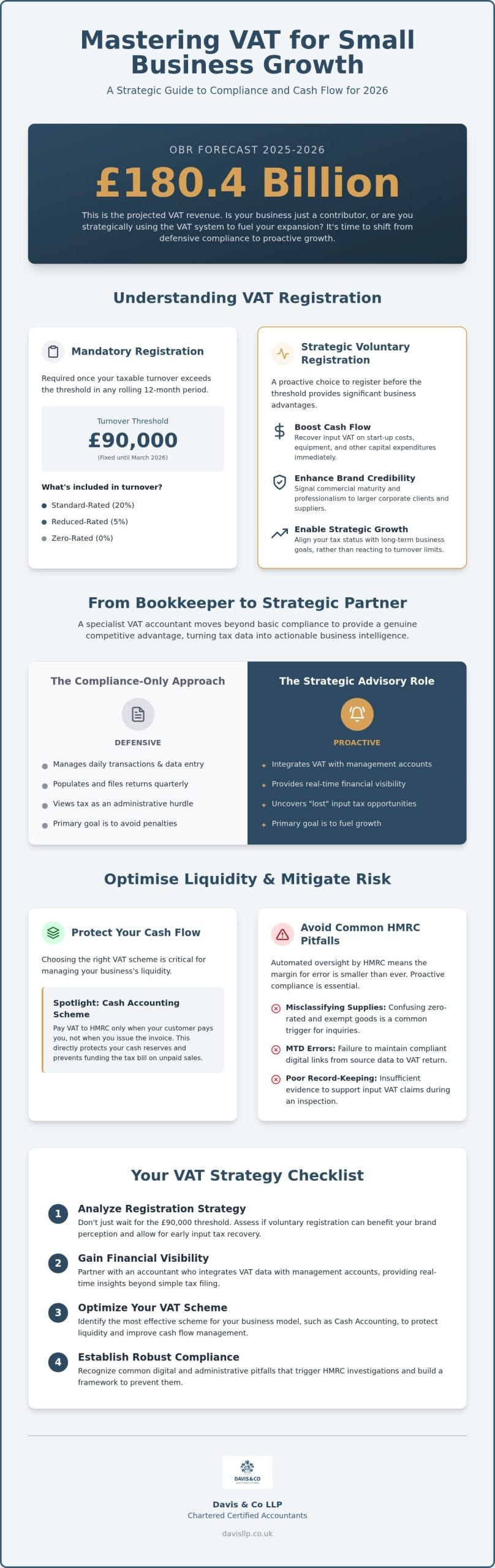
With the Office for Budget Responsibility forecasting VAT receipts to reach £180.4 billion for the 2025-2026 period, is your firm merely contributing to the treasury, or are you utilizing the tax system to fuel your own expansion? Managing these obligations often feels like a defensive exercise against HMRC penalties and the complexities of Making Tax Digital. Engaging a dedicated VAT accountant for small business shifts this dynamic, ensuring that your filings aren’t only precise but also strategically aligned with your broader commercial objectives.
We recognize that the constant evolution of tax legislation and the risk of a points-based penalty system can be a significant source of concern for ambitious directors. This article will demonstrate how specialist oversight provides total peace of mind regarding compliance while simultaneously uncovering opportunities to improve your liquidity through the most appropriate VAT schemes. We’ll examine the specific strategic adjustments and advisory insights that support sustainable business growth, moving beyond simple bookkeeping to provide a genuine competitive advantage in the 2026 fiscal environment.
Key Takeaways
- Understand the 2026 registration thresholds and why voluntary registration can be a strategic move for brand perception and input tax recovery.
- Learn how a VAT accountant for small business acts as a strategic partner, integrating tax data with management accounts to provide real-time financial visibility.
- Identify the most effective VAT schemes, such as Cash Accounting, to optimize your business’s liquidity and protect your cash flow.
- Recognize the common digital and administrative pitfalls that trigger HMRC investigations and how to establish robust compliance frameworks.
- Discover how aligning VAT compliance with broader audit and assurance services creates a foundation for sustainable business growth and long-term stability.
The Evolving VAT Landscape for UK Small Businesses
The UK Value-Added Tax (VAT) system places a unique administrative burden on the entrepreneur. Rather than being a direct tax on your profits, it’s a consumption tax where your company effectively acts as an unpaid collection agent for HMRC. This responsibility requires a high degree of precision. In an environment where HMRC’s oversight is increasingly automated, the margin for error has narrowed significantly. Making Tax Digital (MTD) is no longer a novel software requirement; it’s the baseline compliance standard that dictates how financial data must flow from your business to the authorities. For many, the complexities of digital links and real-time reporting mean that a DIY approach carries risks that far outweigh the perceived savings of manual filing.
Understanding Your VAT Obligations
Your obligations begin once your taxable turnover exceeds the mandatory registration threshold, which remains fixed at £90,000 until March 2026. Taxable turnover includes all supplies that aren’t exempt, encompassing standard-rated (20%), reduced-rated (5%), and zero-rated (0%) goods or services. It’s a common misconception that zero-rated sales don’t count toward the threshold. Misclassifying these supplies is a frequent catalyst for HMRC inquiries. A specialist VAT accountant for small business ensures that every transaction is categorized correctly from the outset, preventing the retrospective assessments that can devastate a company’s reserves.
The Strategic Case for Voluntary Registration
While the threshold provides a ceiling, many directors find that voluntary registration is a prudent move for business growth. Registering before it’s legally required allows you to recover input VAT on significant startup costs and capital expenditure, which directly bolsters your cash flow. Beyond the financial recovery, being VAT-registered often enhances your brand’s credibility. It signals to larger corporate clients and suppliers that your operation has reached a certain level of commercial maturity. We often advise clients that the decision to register should be a proactive choice based on long-term strategy rather than a reactive response to hitting a turnover limit. Partnering with a VAT accountant for small business allows you to weigh these benefits against the administrative requirements, ensuring your tax status supports your broader goals.
The Strategic Role of a VAT Accountant for Small Business
While many directors view tax as a quarterly administrative hurdle, a sophisticated approach transforms it into a powerful tool for financial optimization. A VAT accountant for small business does more than populate boxes on a return; they act as a strategic partner who interprets data to drive better commercial decisions. By integrating VAT data with your management accounts, we provide real-time financial visibility that allows you to see the true health of your operation rather than just a historical snapshot. This integration is vital for identifying “lost” input tax recovery opportunities that automated software often overlooks, particularly in complex areas like employee expenses or partially exempt supplies.
Cross-border trade adds another layer of complexity that requires professional oversight. Navigating international VAT rules, especially in the post-Brexit landscape, demands a deep understanding of place-of-supply rules and import procedures. We ensure your business remains compliant across multiple jurisdictions, preventing the costly delays and penalties that can arise from misunderstood international obligations. This level of precision is essential for maintaining smooth operations and protecting your reputation with global partners.
VAT and Cash Flow Management
Effective tax planning is synonymous with effective liquidity management. We help you time your filings and payments to align with your business’s natural cash cycles, ensuring that funds are available when they’re needed most. By using VAT data to forecast future liabilities accurately, we provide a clear roadmap for your financial commitments. Strategic oversight ensures that VAT is factored into your financial planning, effectively preventing the tax bill shock that can occur when liabilities aren’t anticipated.
Advisory vs. Compliance-Only Services
The distinction between a standard bookkeeper and a Chartered Certified Accountant is significant. While a bookkeeper manages daily transactions, an advisor provides bespoke guidance on business restructuring and its long-term VAT implications. Our specialist sector knowledge in areas like property or dental tax ensures that niche regulations are applied correctly. This high-calibre advisory prevents the expensive errors that generalist firms might miss, positioning your business for sustainable success through tailored VAT compliance support. We focus on the human and organizational impact of these complex issues, ensuring you feel secure and well-advised at every stage of your growth journey.
Selecting the Optimal VAT Scheme for Your Operations
Choosing a VAT scheme is a fundamental strategic decision that directly influences your company’s liquidity. While many directors default to standard accounting, the “wrong” choice can lead to significant overpayment or, more commonly, a cash flow deficit where tax is paid to HMRC before the customer has settled their invoice. A VAT accountant for small business evaluates your specific transaction patterns to determine which framework aligns with your commercial reality. Beyond the standard and cash-based options, the Annual Accounting Scheme can simplify the administrative cycle for stable businesses by reducing the frequency of filings to once per year, supplemented by interim payments.
The Flat Rate Scheme, once a staple for small enterprises, requires careful reassessment in the 2026 fiscal environment. Since the introduction of “limited cost trader” rules, the financial benefits have diminished for many service-led firms. However, for those with higher relevant expenditure, it may still offer administrative simplicity and modest savings. We analyze your cost structures to ensure you aren’t adhering to a legacy scheme that no longer serves your financial interests.
Standard vs. Cash Accounting
The distinction between standard and cash accounting rests on the timing of your liability. Standard accounting triggers VAT on the date of the invoice, which can be problematic if your clients operate on extended payment terms. Conversely, cash accounting allows you to delay the VAT payment until you’ve actually received the funds. This is often the superior choice for service-based businesses or those with high accounts receivable. As your turnover increases toward the £1.35 million threshold for cash accounting, we manage the transition to ensure your records remain robust and compliant during the shift.
Specialist VAT Considerations by Industry
Generalist advice often falls short when dealing with sector-specific nuances. For instance, dental practices and healthcare providers frequently deal with a mix of taxable and exempt supplies. This triggers “partial exemption” rules, a complex area where input tax must be meticulously apportioned. Incorrectly claiming VAT on expenses related to exempt healthcare services is a common error that invites HMRC scrutiny. Our status as a dental tax specialist ensures these calculations are handled with the necessary precision.
Similarly, property transactions and development carry unique risks, such as the “option to tax” and various zero-rating opportunities for specific construction types. Without specialist oversight, businesses risk missing out on substantial recovery opportunities or inadvertently creating large, unrecoverable tax liabilities. We provide the intellectual rigour required to navigate these industry-specific challenges, ensuring your VAT strategy supports your long-term Business Growth Acceleration goals.
Mitigating Risk: HMRC Compliance and the Cost of Error
HMRC investigations aren’t merely random occurrences; they’re increasingly driven by sophisticated data analytics that identify discrepancies in real time. The anatomy of an inquiry typically begins with a request for specific transaction records, which can quickly escalate into a comprehensive inspection of your entire digital audit trail. Common pitfalls include the absence of valid VAT invoices for input tax claims or, more critically in the 2026 environment, a failure to maintain “digital links” between software modules. Engaging a specialist VAT accountant for small business ensures that these technical requirements are met, transforming your tax function from a vulnerability into a robustly defended asset.
The penalty regime has evolved into a points-based system where even minor, persistent administrative oversights can accumulate into significant financial liabilities. With late payment penalties becoming steeper since 2025, the cost of a single error can far exceed the investment in professional oversight. For firms operating across borders, the risks are further compounded. Navigating the post-Brexit landscape requires integrated international tax planning to manage complex import VAT and place-of-supply rules. We act as your strategic partner, ensuring that your global operations aren’t hampered by avoidable compliance failures.
The Importance of Digital Record Keeping
Under Making Tax Digital (MTD) standards, manual data transfer between disparate spreadsheets is no longer sufficient. Your software architecture must utilize digital links to ensure that data remains untainted from the point of entry to the final submission. We help you implement automated bookkeeping workflows that significantly reduce human error while providing the real-time visibility mentioned in previous sections. Davis & Co LLP ensures your digital audit trail is robust enough to withstand the most rigorous scrutiny, providing a transparent and verifiable record of your commercial activities.
Handling HMRC Inquiries with Confidence
If your business is selected for an inquiry, the presence of a Chartered Certified Accountant to represent your interests is vital. We manage all correspondence with HMRC, ensuring that information is presented accurately and with the necessary professional discretion. Often, proactive disclosure of an inadvertent error can mitigate penalties before they’re officially assessed. Professional representation serves as the primary shield against the stress and financial uncertainty of HMRC scrutiny. To protect your business from the costs of non-compliance, consider a consultation regarding our VAT Compliance services.
Bespoke VAT Solutions with Davis & Co LLP
Davis & Co LLP offers a high-calibre alternative to the transactional nature of high-volume accounting firms. We provide highly individualized service for small businesses across the nation, ensuring that your specific commercial objectives are at the forefront of our advisory. By acting as a specialist VAT accountant for small business, we move beyond simple compliance to offer a partnership that values reliability and discretion. This approach often involves integrating your VAT compliance with audit and assurance services. This creates total transparency within your financial records, providing a foundation of trust that’s essential for long-term stability and stakeholder confidence. We don’t just file returns; we build a robust financial framework that supports your reputation.
Our composed partnership model is designed to make you feel secure and well-advised without sacrificing the necessary distance of a professional expert. We recognize that as a director, your time is best spent on core operations rather than deciphering the nuances of tax legislation. By entrusting your VAT obligations to us, you gain access to deep-seated expertise that anticipates challenges before they manifest as HMRC inquiries. This proactive stance is a hallmark of our service, reflecting a commitment to quiet excellence that has defined our practice for years. We position ourselves as a strategic partner, ensuring that every tax decision contributes to your broader business goals.
A Holistic Approach to Small Business Finance
We believe that financial clarity isn’t achieved through fragmented services. Instead, we combine VAT management with payroll and bookkeeping to create a unified financial function. This holistic perspective allows our strategic growth advisory to be informed by real-time data, ensuring that decisions regarding expansion or investment are grounded in fiscal reality. Our role as a trusted advisor is built on the understanding that your business is a dynamic entity where tax, operations, and growth are inextricably linked. We focus on the organizational impact of complex tax issues, providing the steady, deliberate guidance you need to navigate the 2026 fiscal landscape with certainty. This integrated method ensures that your Cash Flow Management remains optimized throughout the year.
Contacting Our Specialist Team
Taking the next step toward optimized tax management begins with a strategic review of your current position. We invite you to arrange a consultation with our team to discuss how our bespoke solutions can protect your liquidity and ensure total compliance. To prepare for your initial review, it’s helpful to have your recent VAT returns and an overview of any cross-border transactions ready for analysis. This allows us to provide specific, actionable insights from our first interaction, focusing on immediate recovery opportunities and long-term risk mitigation. Experience the intellectual rigour and polished service that characterizes our practice and discover why so many firms choose us as their long-term strategic partner for Business Growth Acceleration.
Secure Your Financial Future with Strategic VAT Oversight
Navigating the complexities of UK tax requires more than just adherence to deadlines; it demands a proactive strategy that aligns with your long-term commercial goals. We’ve explored how the right accounting scheme can optimize your liquidity and how precise digital record-keeping serves as a robust defense against HMRC scrutiny. By engaging a specialist VAT accountant for small business, you transform a potentially burdensome administrative task into a clear advantage for your company’s growth.
As Chartered Certified Accountants with over 120 years of professional excellence, we provide the steady, deliberate guidance necessary to thrive in an increasingly automated regulatory environment. Our status as specialists in SME growth and compliance ensures that your financial function is both transparent and resilient. We invite you to request a consultation with our specialist VAT team to conduct a thorough review of your current position. Together, we can establish a foundation of fiscal stability that allows you to focus on the human and organizational impact of your work. We look forward to supporting your continued success.
Frequently Asked Questions
Do I need a VAT accountant if I use accounting software?
Software is a valuable tool for data entry and basic MTD compliance, but it cannot replace the strategic oversight of a qualified professional. A VAT accountant for small business ensures that your software is configured correctly and that you’re utilizing the most efficient schemes for your specific industry. We provide the intellectual rigour to identify errors that automated systems often overlook, such as partial exemption nuances or incorrect digital links. This oversight prevents the administrative errors that frequently trigger HMRC inquiries.
What is the current VAT registration threshold for 2026?
The mandatory VAT registration threshold is currently £90,000, and this figure remains fixed until March 2026. You’re required to register if your taxable turnover for the previous 12 months exceeds this limit or if you expect it to do so within the next 30 days. It’s vital to monitor this rolling total monthly rather than annually. We assist our clients in tracking these figures precisely to ensure they don’t inadvertently breach the limit and face retrospective assessments.
Can a VAT accountant help me reclaim past VAT?
Yes, we can often identify and recover input tax on legitimate business expenses incurred before your official registration date. Generally, you can reclaim VAT on goods purchased up to four years prior and on services received up to six months before registration, provided they were for business use. We conduct thorough reviews of your historical records to ensure no recovery opportunity is missed. This process significantly improves your initial cash flow following a successful registration.
How much does a VAT accountant typically cost for a small business?
Professional fees for VAT services are determined by the complexity of your operations and the level of advisory required for your specific sector. Rather than providing a fixed industry average, we offer bespoke quotes that reflect your needs, whether you require simple compliance or integrated international tax planning. Our focus remains on delivering high-calibre service that offsets the cost through risk mitigation and strategic tax management. This individualized approach ensures you only pay for the expertise your business actually utilizes.
What happens if I register for VAT late?
Registering late typically results in a failure to notify penalty and a requirement to pay all the VAT due from the date you should have registered. HMRC’s points-based system and late payment penalties have become increasingly stringent since 2025. We help businesses navigate the disclosure process to mitigate these charges where possible. By presenting your case professionally and ensuring future compliance is robust, we work to protect your commercial interests during the regularization of your tax status.
Can I change my VAT scheme once I am registered?
You can change your VAT scheme, provided your business continues to meet the eligibility criteria for the new framework. This transition is usually best handled at the start of a new VAT period to maintain clear and consistent records. We evaluate your current turnover and cash flow requirements to determine if moving from standard accounting to cash accounting would be beneficial. This flexibility ensures your tax management remains aligned with your evolving commercial reality and liquidity needs.
How does Making Tax Digital (MTD) affect my VAT filings?
MTD mandates that all VAT-registered businesses maintain digital records and submit returns through compatible software. Crucially, the regulations require digital links between all pieces of software used in your tax journey. This means manual copying and pasting of data is no longer permitted. We ensure your digital audit trail is fully compliant, reducing the risk of human error and providing the transparency required by HMRC’s increasingly automated oversight systems. This digital integration is essential for modern compliance.
Is it better to be VAT registered or not for a small business?
The decision depends on your customer base and cost structure. If you primarily serve VAT-registered businesses, registration allows you to recover input tax without impacting your competitive pricing. However, for those serving the general public, registration may effectively increase your prices by the standard 20% rate. Engaging a VAT accountant for small business allows you to perform a detailed cost-benefit analysis. We help you determine whether voluntary registration supports your long-term growth and enhances your brand credibility.